


Who’s Watching? How peer observation affects the way teenagers learn from their mistakes
Last week, I was trying to park my car at home. I always reverse park, and if I say so myself, I’m usually pretty good at it. But this time, a car was waiting for me to park so it could pass. Suddenly, I couldn’t seem to get it right. Knowing that someone was watching me made me overthink every move. I kept getting the angle wrong, which made me feel increasingly frustrated and a little embarrassed. Eventually, I managed to park the car, but it took me way longer than normal and the whole experience left me quite stressed. That feeling of being observed isn’t unique to awkward parking situations. In fact, it is something teenagers experience every day.
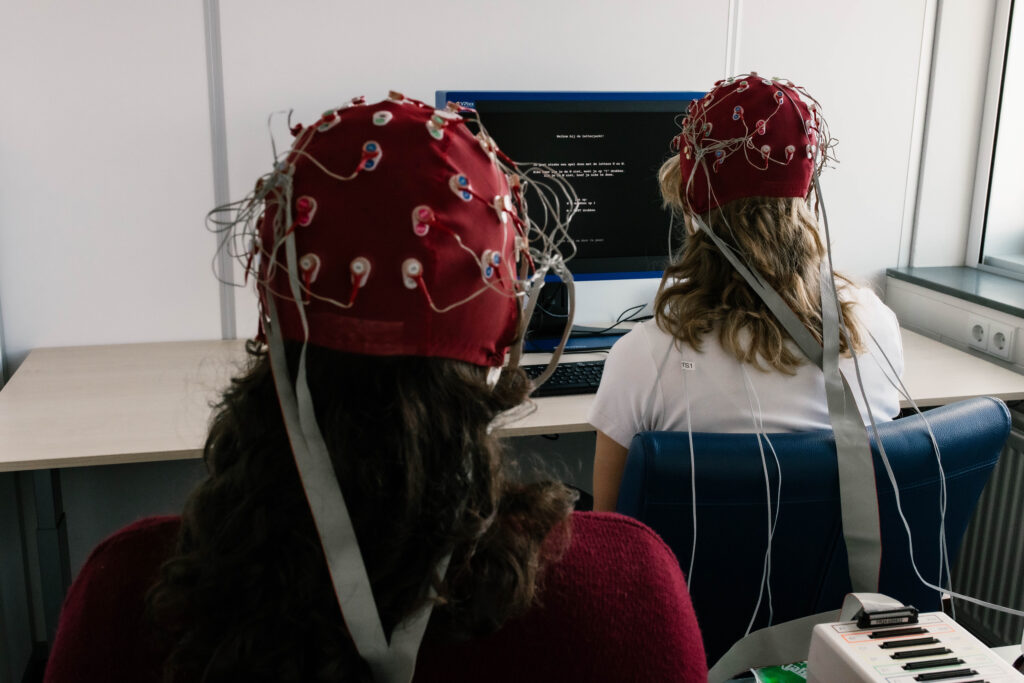
In my PhD as part of the Growing Up Together in Society (GUTS) project, I am interested in what happens in the brain of teenagers when they are being watched while making a mistake. Some research has shown that the brain responds stronger to mistakes when someone is watching compared to when your alone. This may be especially relevant during adolescence, when peers become increasingly important. In the teenage brain, we see increased activity in reward-related regions during social situations, suggesting that peer approval can feel particularly motivating. At the same time, teenagers are constantly surrounded by other people: in the classroom, during sports, or when hanging out with friends. As a result, they often learn and make mistakes while peers are around. But surprisingly, this hasn’t been studied very much in the lab. One reason is quite practical: it can already be a challenge to get one teenager to the lab on time, let alone two!
In our study, however, we managed to bring around 400 young people into the lab. They played a game where mistakes were easily made, while another young person watched them. At the same time, we measured their brain activity. We found that being watched changed how adolescents responded to their mistakes. Their brains showed stronger responses when they became aware of a mistake and when they needed to stop or adjust their behavior. Interestingly, we did not see the same effect in the brain’s very first, automatic reaction to making a mistake – the quick “oops!” response that happens before we are even fully aware that we made an error.
We are excited to explore these findings further and understand what they might mean for young people’s learning experiences. After all, making mistakes is normal and an important part of learning, but perhaps who is around us when making those mistakes matters more than we realize.
Understanding this could help us, as researchers, gain a better insight into the brain and the processes involved in learning. It could also help teachers create a healthy and supportive learning environment in the classroom. And, perhaps most importantly, it could help teenagers themselves become more aware of how the people around them can influence their learning – also perhaps positively. Being aware of these social influences could ultimately help make learning a more positive and enjoyable experience.
Contact
Erasmus University Rotterdam
Mandeville Building T13
Burgemeester Oudlaan 50
3062 PA Rotterdam, the Netherlands